An AI-assisted tool designed to help high school and early college students explore career pathways with confidence — through structured guidance, transparent comparisons, and space to reflect.
The Problem
Many high school and early college students struggle to explore career paths not because there's too little information — but because there's no structure to help them process it. Without access to counselors, mentors, or professional networks, students default to guesswork.
Research on career self-efficacy shows that students with low confidence and limited guidance are more likely to experience long-term occupational disadvantages — a pattern sometimes called the "drift effect." The problem is especially pronounced in under-resourced communities.
Students bounce between scattered resources with no framework for comparing or deciding.
Professional networks and mentorship are unevenly distributed — first-gen and low-income students bear the most risk.
Existing tools present final answers. Students need a thinking partner — not something that decides for them.
Students can't easily compare salary, education time, job stability, or flexibility side by side.
Design Approach
Rather than presenting a single career answer, the system guides students through three phases that mirror how decisions actually get made — gradually, through comparison and reflection, not in one decisive moment.
The system gathers context — grade, activities, interests, worries, and constraints — using progressive disclosure. AI highlights interest connections in real time.
Students select career pathways to compare side-by-side on a radar chart across cost, speed, salary, and flexibility — "there's no single winner here."
A structured reflection captures what resonated and what's still uncertain. Students can optionally share a summary with a counselor or teacher.
Step 1 — Check In & Explore
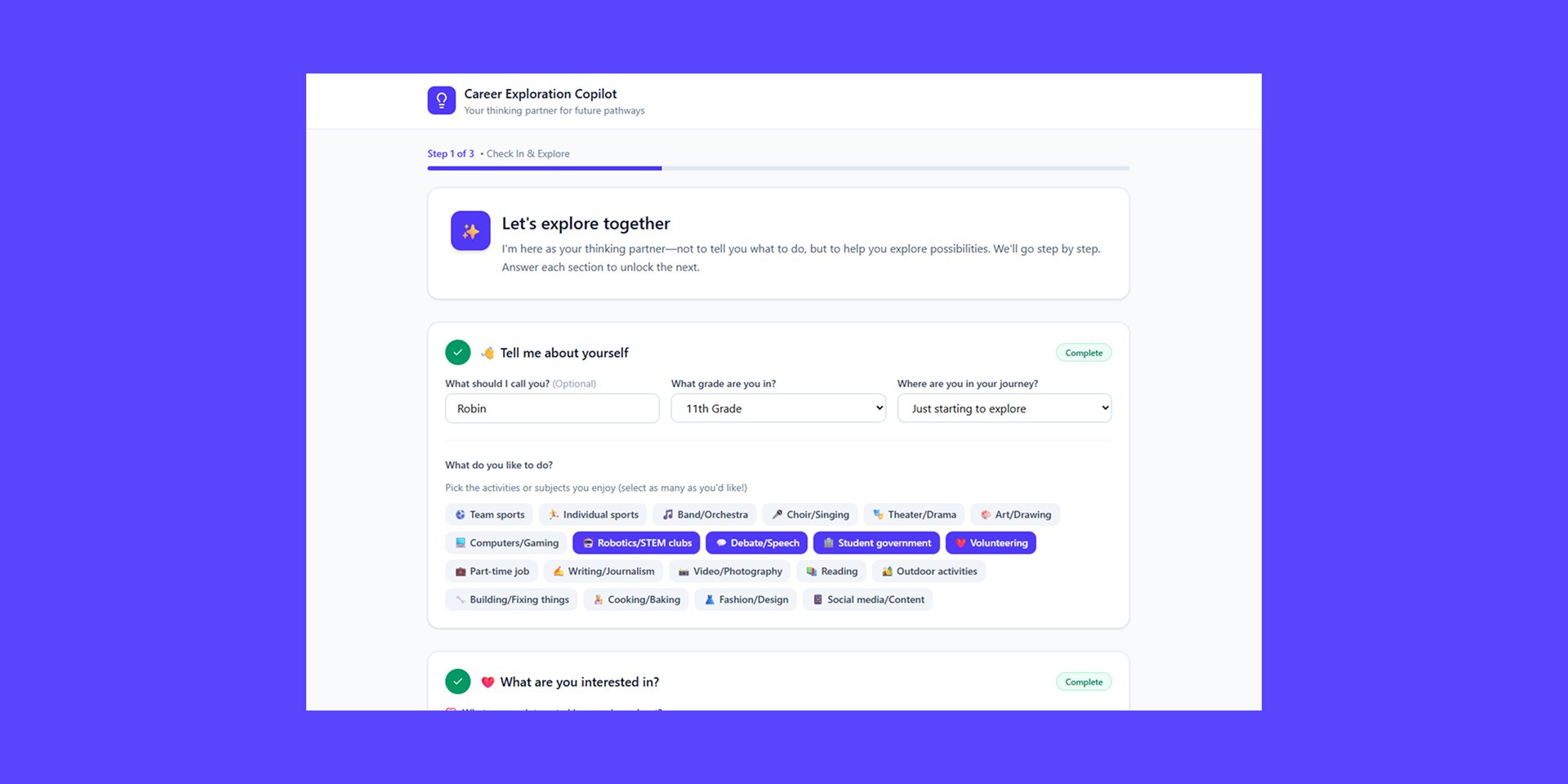
The intake flow was designed to feel conversational, not bureaucratic. Progressive disclosure keeps each section focused. AI highlights likely interests based on the student's selected activities.

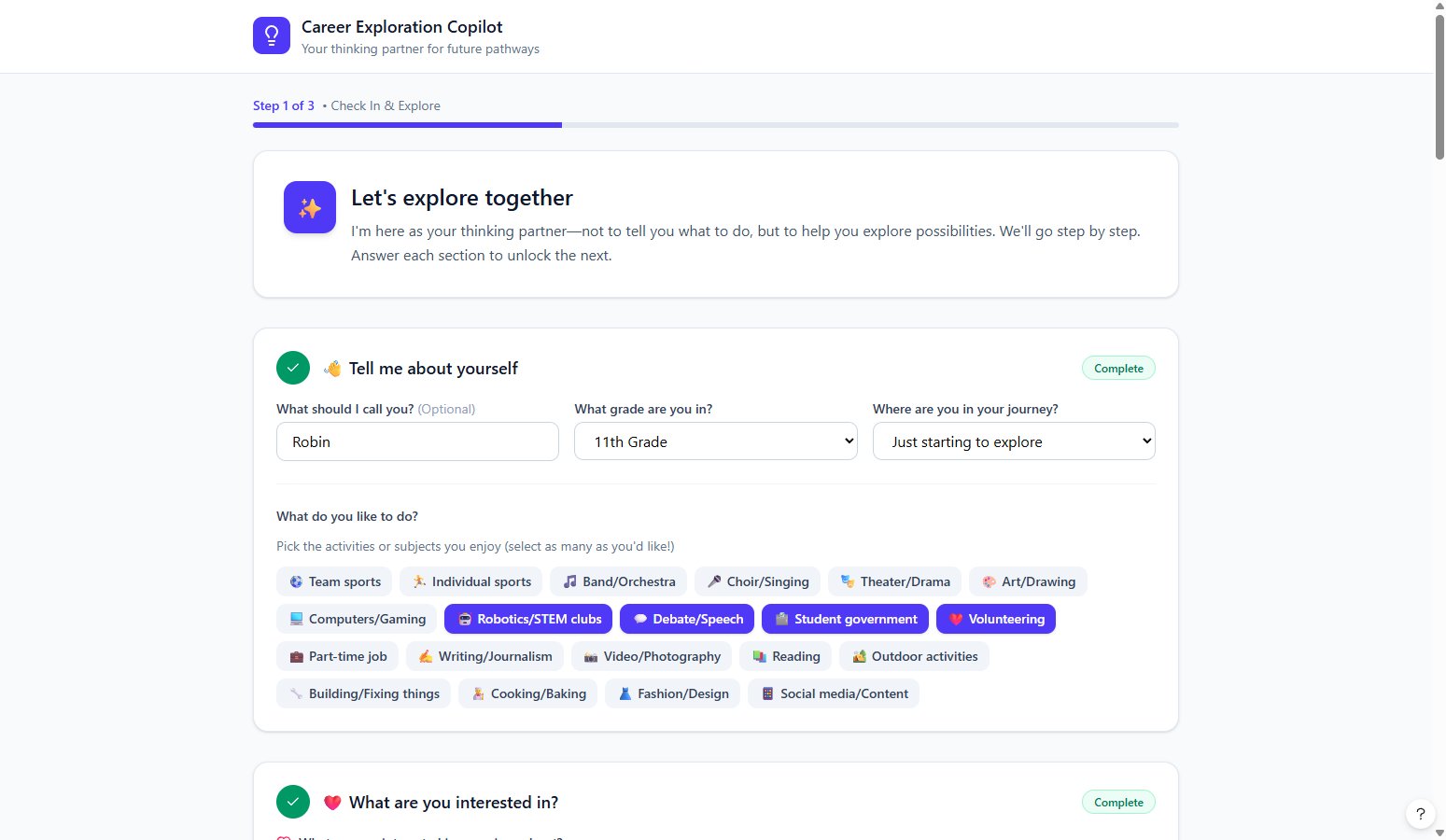
Step 1 of 3 — Tell me about yourself. Name, grade, and journey stage are collected first. Activity tags let students express themselves without writing — low friction, high signal.

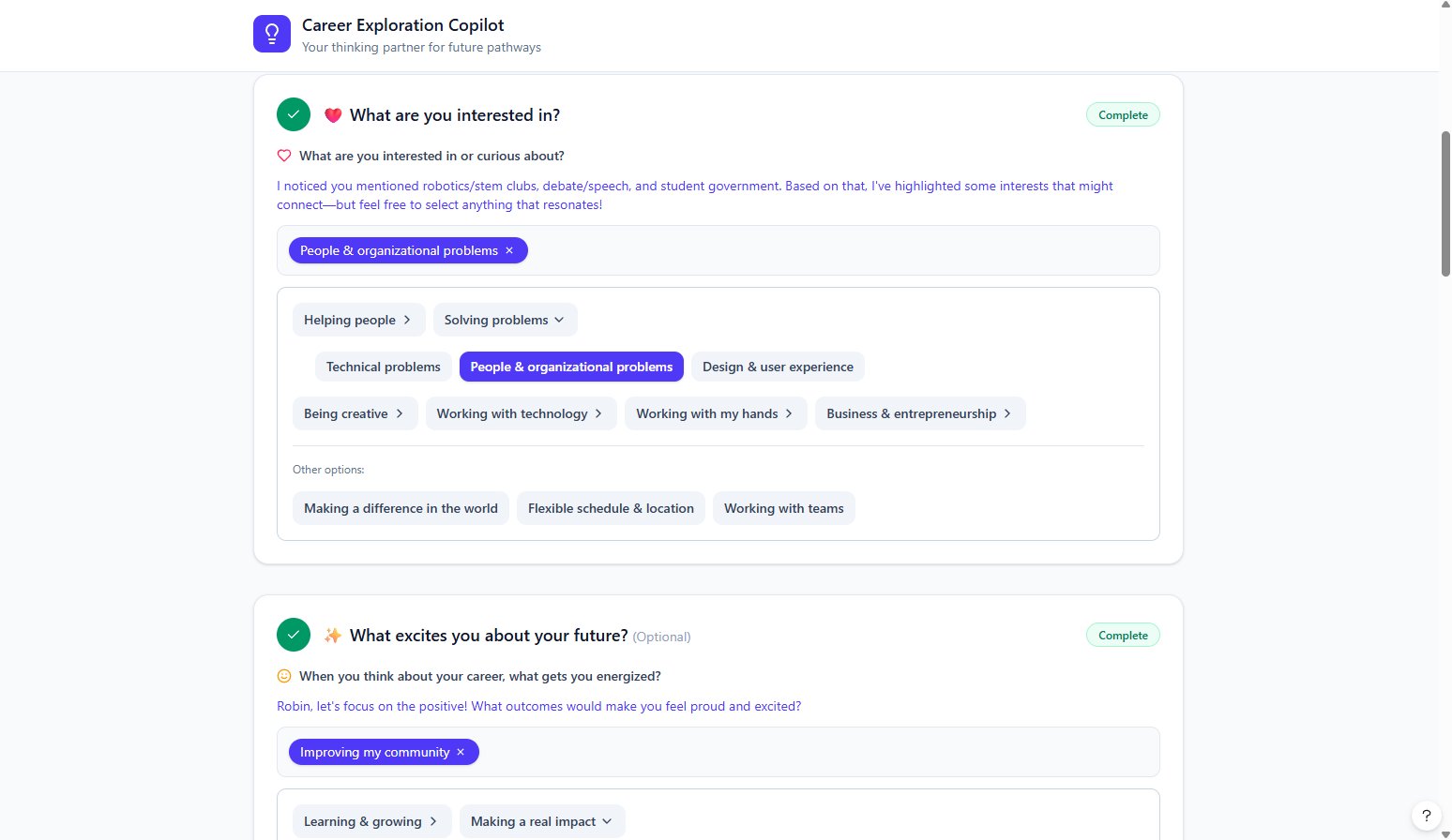
AI-assisted interest mapping. Based on selected activities, the system highlights relevant interest clusters — building trust through transparency.

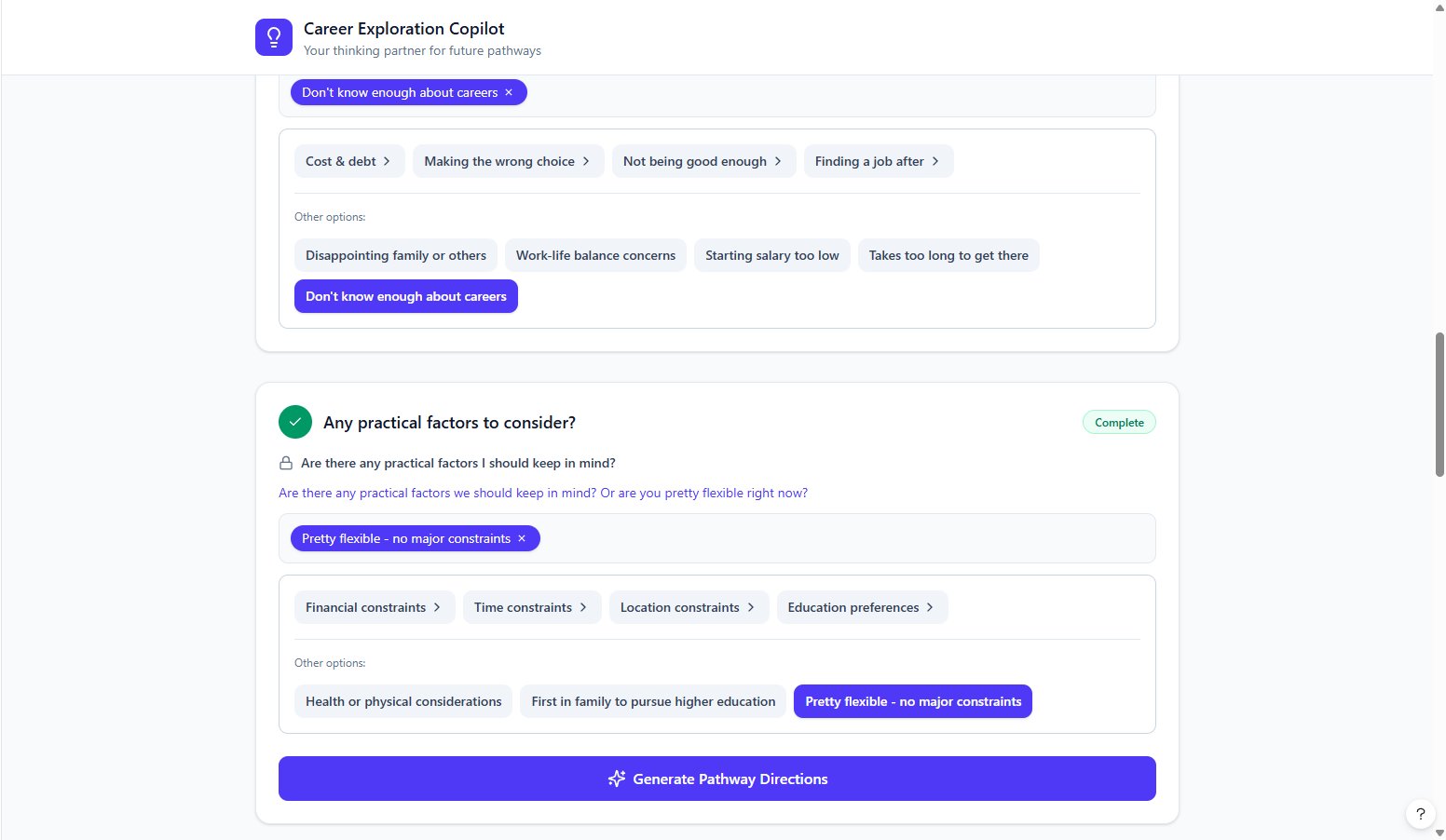
Constraints and Generate. The CTA only appears once all sections are complete, preventing premature results.
Results
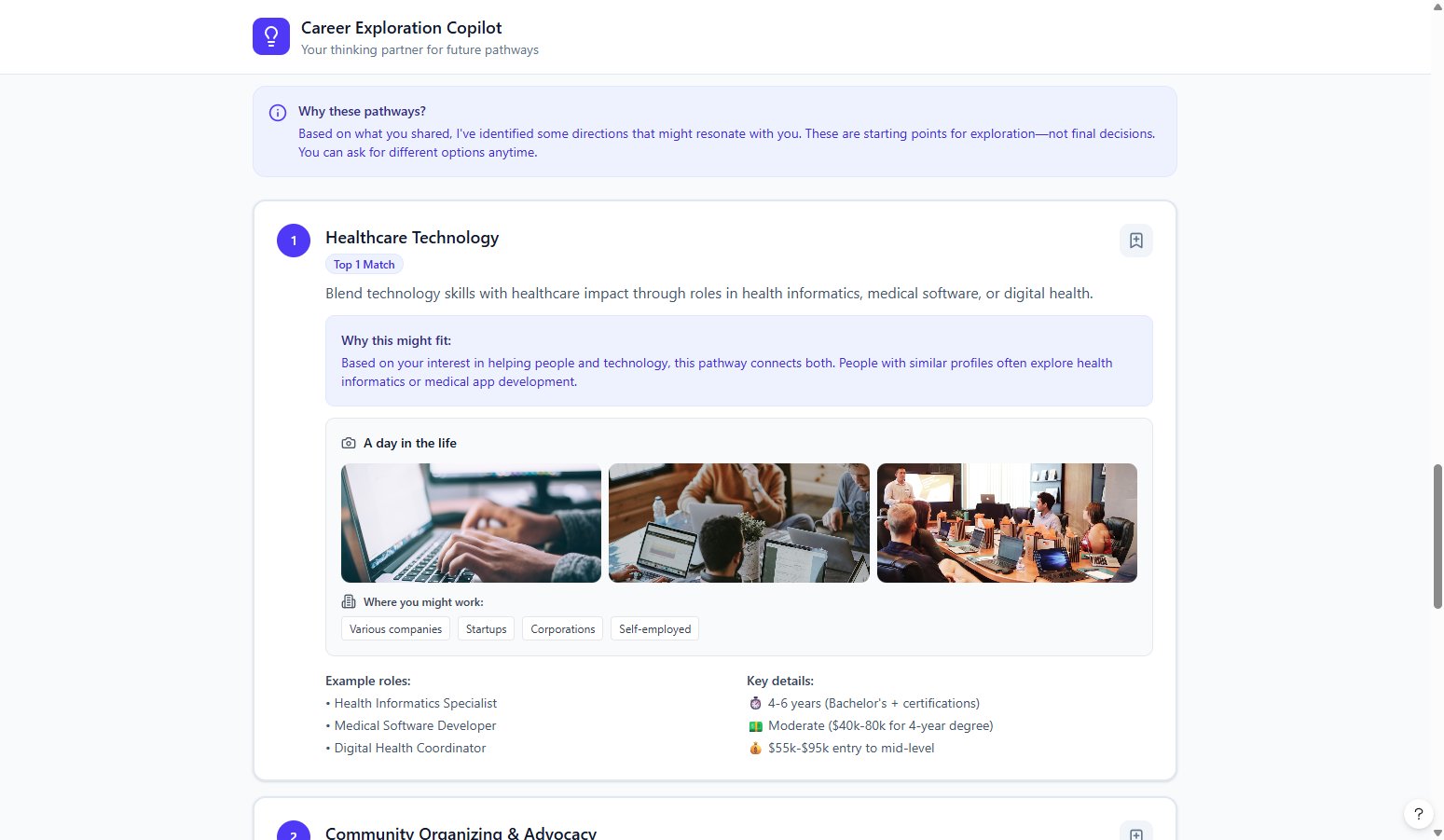
The results page leads with a key framing: "These are starting points for exploration — not final decisions." A "Why this might fit" explanation shows exactly which inputs shaped the recommendation.

Healthcare Technology — Top 1 Match. The "Why this might fit" block links the recommendation directly to the student's inputs.

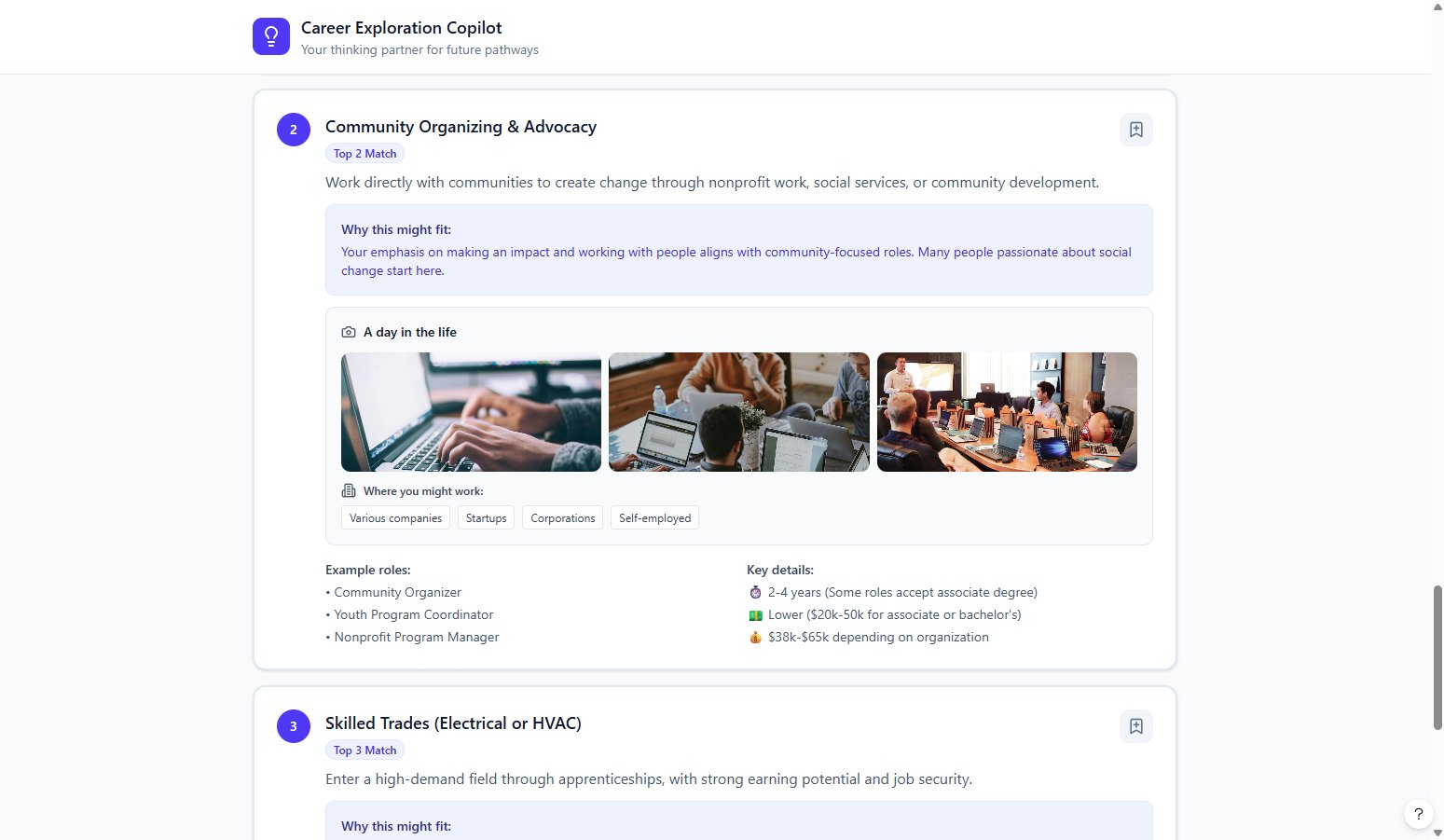
Multiple pathways ranked. Students see several options — not just one, directly addressing the "over-reliance" risk.
Step 2 — Compare & Question
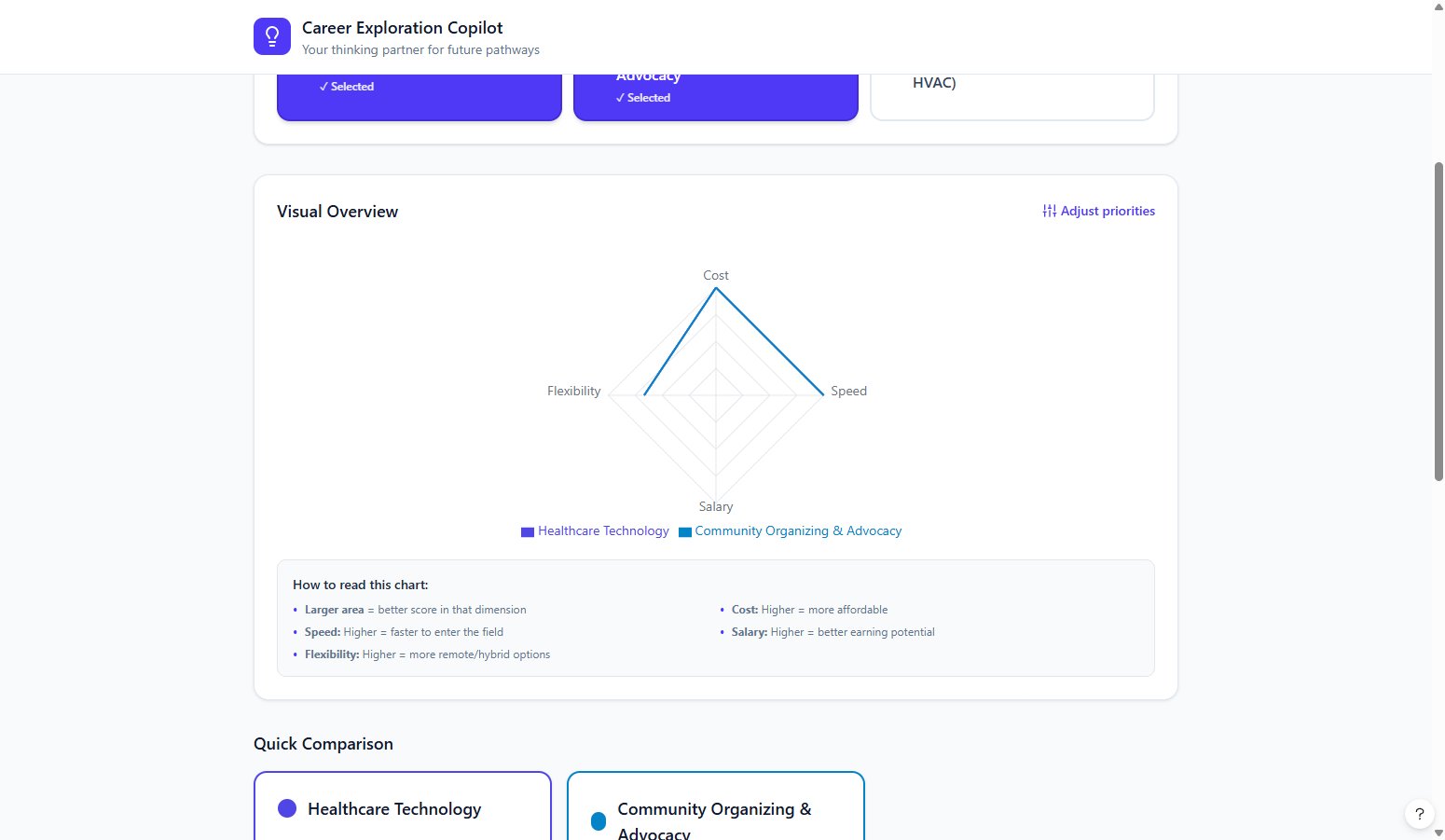
Instead of ranking pathways by a single score, a radar chart shows how each option performs across four dimensions simultaneously — putting students in control of the evaluation criteria.

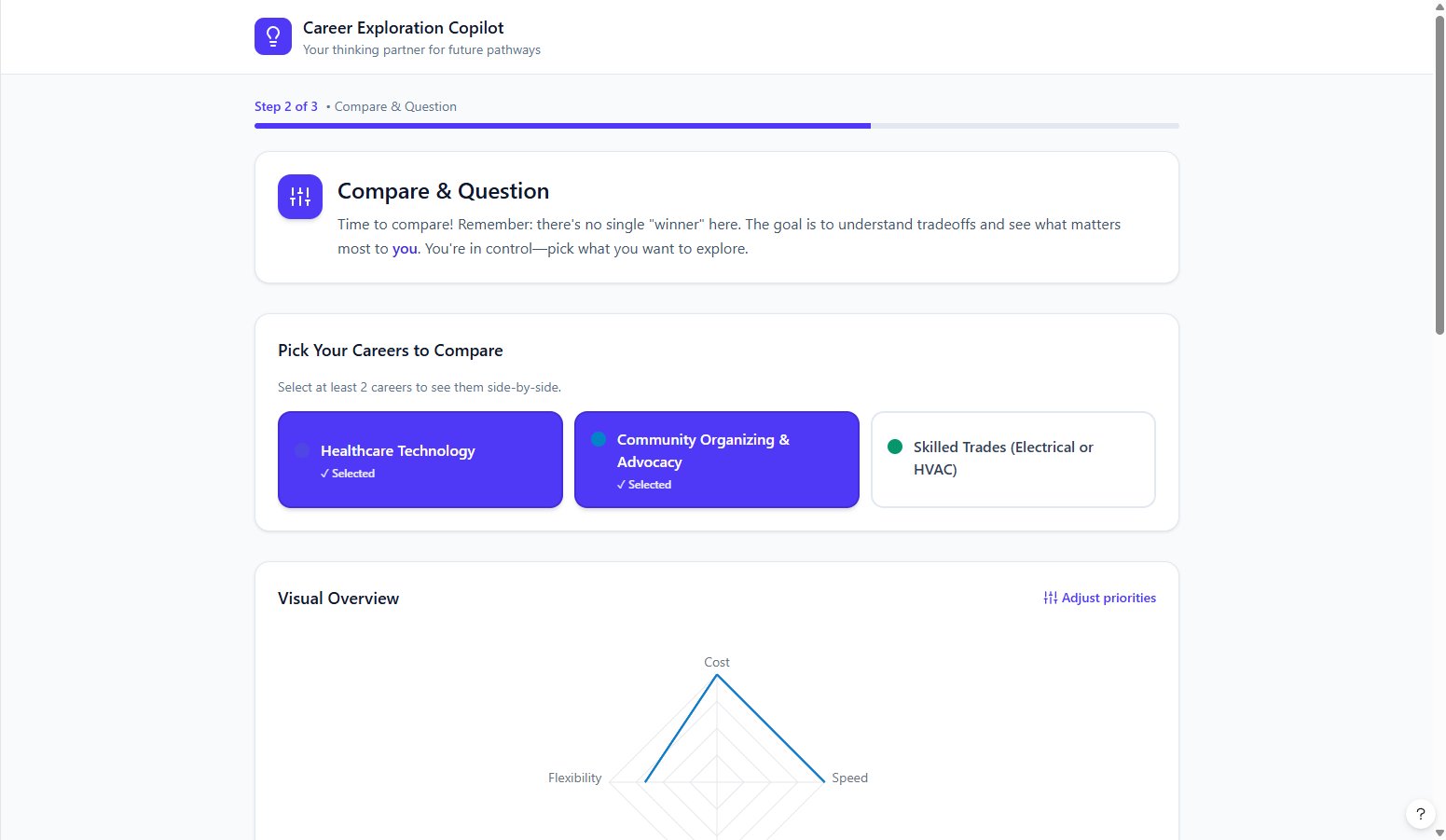
Career selection. Students pick at least two pathways to compare side-by-side.

Visual Overview radar chart. A "How to read this chart" guide is built in for first-time readers.
Step 3 — Reflect & Hand Off
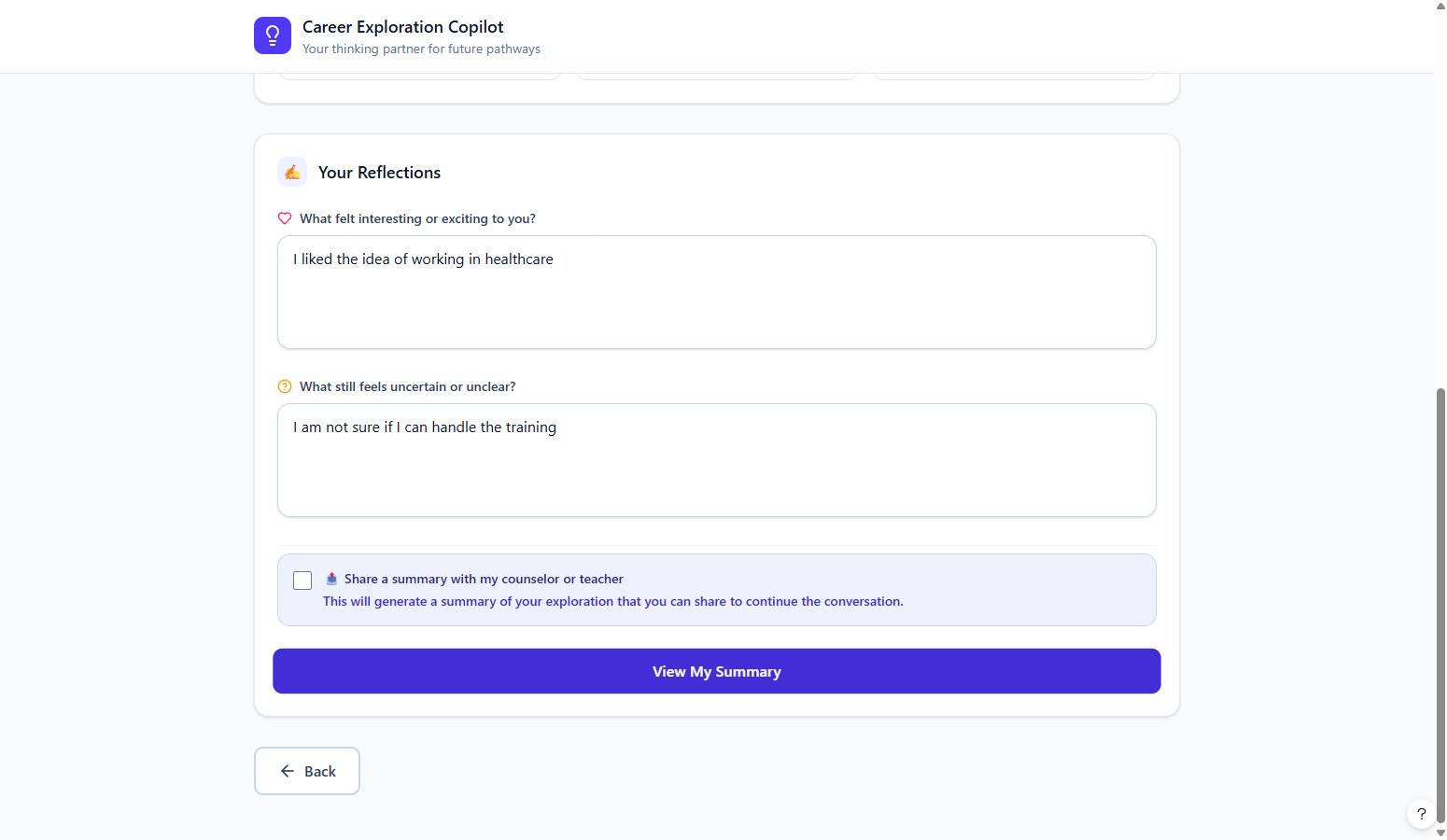
After exploring and comparing, students articulate what resonated and what's still uncertain. An optional counselor handoff converts the AI session into a starting point for a real human conversation.

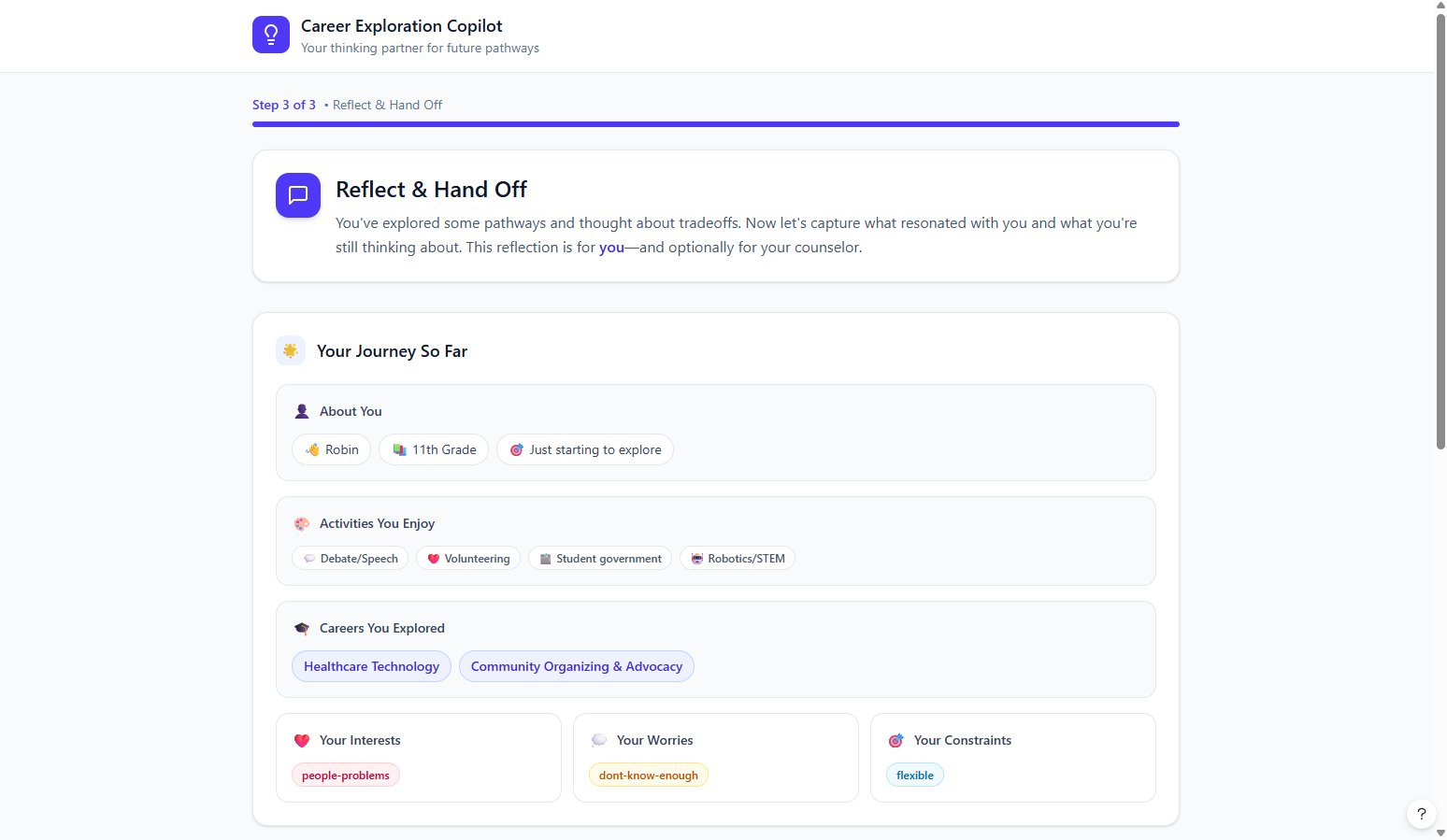
Journey summary. Everything the student shared is reflected back — building confidence that the system understood them.

Reflections + handoff. The counselor share checkbox is deliberately optional.

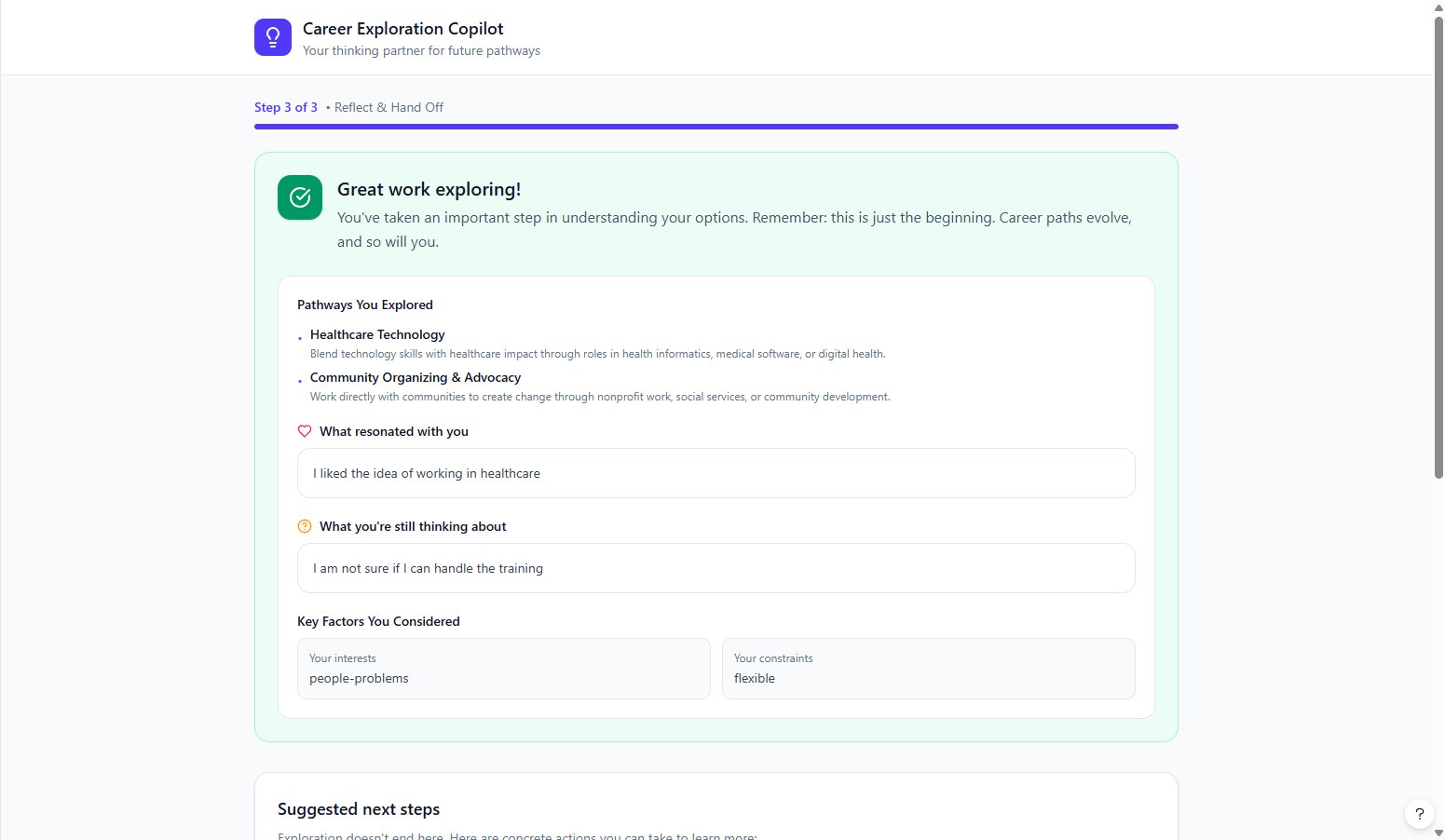
Final summary. A clean readout of pathways explored, reflections, and key factors — with suggested next steps.
Try the interactive prototype
Walk through the full Explore → Compare → Reflect flow.
Evaluation
Evaluation used a combination of synthetic user testing (3 AI-generated personas) and one human participant. The contrast between the two was itself a finding.
Both synthetic and human participants appreciated the step-by-step flow, moving from overwhelmed to focused on pathways they could evaluate clearly.
Adding the "Why this might fit" block — linking each recommendation to the student's inputs — resolved this.
The human participant wanted to become a pilot. When the system didn't surface that path, he felt frustrated — a reaction that never appeared in synthetic testing.
"It wasn't hard, it just didn't suggest what I actually wanted. It felt like it was telling me what to think."
Human test participant, on the system not surfacing his goal of becoming a pilotAI in the Design Process
This project used AI at multiple stages — research synthesis, persona generation, early prototype evaluation, and interaction design. Working with AI clarified both its capabilities and its hard limits.
AI accelerated synthesis of literature on career self-efficacy, access to guidance, and decision-making challenges.
Synthetic personas helped surface system-level risks — transparency, over-reliance, bias — before any real user testing.
All three synthetic personas raised near-identical concerns despite being different characters. Real user identity and motivation couldn't be replicated.
AI couldn't navigate the Figma prototype directly — testing required manually uploading screenshots per screen.
Reflection
The single most important improvement would be testing with more real users. One human session produced more actionable insight than three synthetic sessions combined. The pilot frustration pointed directly at a design flaw that AI personas never flagged.
The career database needs to be grounded in verified data. Drawing from established sources like the Bureau of Labor Statistics would make recommendations more defensible and the range of pathways more genuinely diverse.
The number of choices shown at each step should be reduced. This system was designed to solve decision fatigue — it shouldn't be adding to it.
Finally, testing should include counselors and parents, not just students. The counselor handoff feature — one of the most important design decisions — was never evaluated from the counselor's side.
"AI is most valuable in early-stage synthesis and structured critique, while human input remains essential for understanding motivation, identity, and emotional response."
From the project reflection